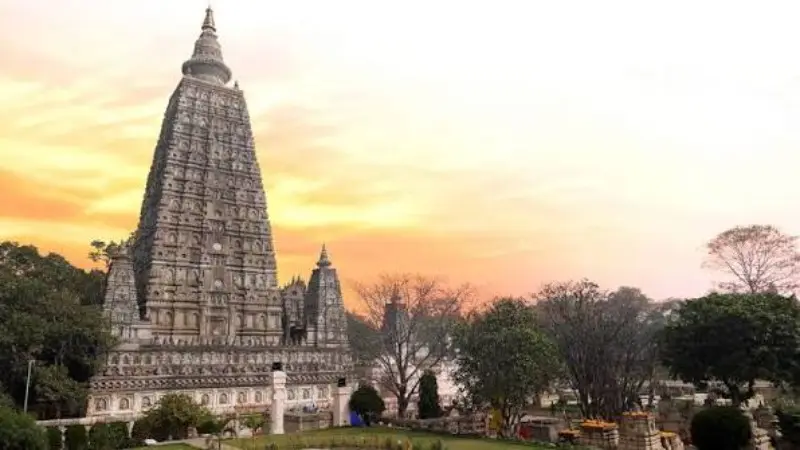
Mahabodhi Temple
World Heritage Site
MAHABODHI TEMPLE, BODH GAYA
A Detailed Historical, Religious, Architectural and Cultural Report
1. Introduction
The Mahabodhi Temple, also known as the Mahābodhi Mahāvihāra, is one of the most important Buddhist monuments in the world. It stands at Bodh Gaya in Bihar, India, at the sacred place traditionally associated with the enlightenment of Siddhartha Gautama, who became the Buddha.
The temple complex is one of the four principal sacred places associated with the life of the Buddha and is regarded as one of the holiest pilgrimage destinations for Buddhists worldwide. The present Mahabodhi Temple is principally associated with the Gupta period, while the sacred site itself has a much older history dating back to the Mauryan period.
2. Location
The Mahabodhi Temple is situated in Bodh Gaya, Gaya district, Bihar, India, in the historic region of Magadha.
The approximate geographical coordinates are:
24°41′46″ N, 84°59′29″ E
The complex is approximately 16 km from Gaya district headquarters. UNESCO identifies the property as covering approximately 4.86 hectares.
3. Connection with the Buddha's Enlightenment
According to Buddhist tradition, Prince Siddhartha Gautama came to the area of present-day Bodh Gaya and meditated beneath a sacred fig tree, now known as the Bodhi Tree.
After deep meditation, Siddhartha attained supreme enlightenment and became the Buddha. The site associated with this event subsequently developed into one of the most important centres of Buddhist pilgrimage.
The Mahabodhi Temple complex therefore represents not merely an architectural monument but a place directly connected with one of the most significant events in the history of Buddhism. UNESCO describes the complex as having a direct association with the Buddha's enlightenment.
4. Mauryan Period and Emperor Ashoka
The history of the Mahabodhi site is closely connected with Emperor Ashoka of the Mauryan Empire.
UNESCO records that Ashoka visited the site in the 3rd century BCE and established an early temple or shrine associated with the Bodhi Tree. The early complex also included a railing and the Vajrasana, traditionally understood as the "Diamond Throne" or seat of enlightenment.
Archaeological evidence indicates that the site was already a place of Buddhist veneration during the Mauryan period.
5. The Vajrasana – Diamond Throne
One of the most sacred objects within the complex is the Vajrasana, traditionally identified as the seat where the Buddha attained enlightenment.
The Vajrasana is associated with Emperor Ashoka and is considered one of the oldest surviving elements of the sacred site. Its presence reinforces the connection between the present temple complex and the ancient Buddhist pilgrimage tradition.
6. Development of the Temple
The present temple is generally dated to the 5th–6th centuries CE, during the Gupta period.
UNESCO considers the Mahabodhi Temple one of the earliest surviving Buddhist temple structures in India built substantially in brick and identifies it as an outstanding example of late Gupta-period architectural achievement.
The temple developed over several centuries, with different rulers, Buddhist communities and pilgrims contributing to the construction, decoration and maintenance of the sacred complex.
7. Accounts of Chinese Buddhist Travellers
The Mahabodhi site was visited and described by important Chinese Buddhist travellers.
The Chinese traveller Faxian (Fa-Hien) visited India in the early 5th century CE and recorded Buddhist sacred places.
Later, Xuanzang (Hiuen-Tsang) visited Bodh Gaya in the 7th century CE. His account describes the large temple, the Bodhi Tree and the surrounding sacred structures.
His description provides valuable historical evidence about the appearance and importance of Bodh Gaya during the early medieval period.
8. Architectural Features
The Mahabodhi Temple is particularly famous for its tall central brick tower, often described as approximately 50 metres high.
Important architectural features include:
- The main Mahabodhi Temple - The central pyramidal tower - Smaller subsidiary towers - The Vajrasana - Sacred Bodhi Tree - Ancient stone railings - Numerous votive stupas - Sculptural panels and Buddha images - Sacred meditation sites - Lotus Pond - Pilgrimage pathways
The temple's architecture combines monumental verticality with intricate decorative elements. Its brick construction is particularly significant because comparatively few early Indian brick temples have survived in such a substantial form.
9. The Sacred Bodhi Tree
The Bodhi Tree is one of the most important features of the Mahabodhi Temple complex.
Buddhist tradition identifies the tree as a descendant of the sacred tree under which the Buddha attained enlightenment.
For pilgrims, the tree is not simply a botanical feature; it represents the Buddha's enlightenment and the continuation of the sacred tradition of Bodh Gaya.
10. Decline and Abandonment
Over the centuries, the importance and condition of the Mahabodhi complex changed.
UNESCO records a prolonged period of decline and abandonment, particularly from approximately the 13th to 18th centuries. During this period, the site suffered from neglect and deterioration.
Nevertheless, the sacred association of Bodh Gaya with the Buddha's enlightenment continued to survive through Buddhist traditions and pilgrimage.
11. Nineteenth-Century Restoration
The Mahabodhi Temple underwent major restoration during the 19th century.
Archaeological investigations and conservation work helped document and stabilize the monument. Alexander Cunningham and other archaeologists played an important role in the study and restoration of the site.
Historical photographs from the late 19th century provide valuable evidence of the temple before and during restoration.
One particularly important historical photograph from 1883 records the Mahabodhi Temple during restoration work, showing scaffolding around the ancient structure.
12. Historical Photograph – Mahabodhi Temple, 1883
Photographic significance: The 1883 photograph provides an important visual record of the temple during its restoration. It shows the tall central brick structure and the conservation work undertaken around the monument.
The photograph is associated with Joseph Beglar and is held in the collections of the Victoria and Albert Museum.
13. Historical Photograph – Mahabodhi Temple in the 1880s
Another historic photograph from the 1880s shows the Mahabodhi Temple after or during the major period of archaeological attention.
The photograph provides a visual comparison between the historic appearance of the complex and its present-day condition.
14. Restoration in the Twentieth Century
Restoration and conservation continued into the 20th century.
The objective of conservation was not simply to repair the structure but also to preserve the historical, archaeological and religious character of the complex.
UNESCO notes that although the temple has experienced repairs and renovations over different periods, its essential architectural features have remained substantially intact.
15. UNESCO World Heritage Status
The Mahabodhi Temple Complex at Bodh Gaya was inscribed on the UNESCO World Heritage List in 2002.
It was recognized under cultural criteria (i), (ii), (iii), (iv) and (vi).
UNESCO considers the complex important because of:
1. Its outstanding architectural achievement. 2. Its influence on the development of Buddhist architecture. 3. Its exceptional historical evidence relating to the Buddha and Buddhist worship. 4. Its importance as an early brick architectural monument. 5. Its direct association with the Buddha's enlightenment.
16. Seven Sacred Places of Enlightenment
The Mahabodhi Temple complex contains important locations associated with the Buddha's period immediately following enlightenment.
Among the traditionally recognized sacred locations are:
- Vajrasana - Bodhi Tree - Animeshlochan Chaitya - Ratnachankrama - Ratnaghara - Ajapala Nigrodha Tree - Rajayatana Tree
These places form an important part of the pilgrimage experience at Bodh Gaya.
17. Religious Importance
For Buddhists, Bodh Gaya is considered the place where the Buddha achieved the supreme insight that became the foundation of Buddhism.
Pilgrims from India and many countries across Asia and the world visit the Mahabodhi Temple for:
- Meditation - Prayer - Buddhist ceremonies - Offering flowers and lamps - Circumambulation - Study of Buddhist teachings - Religious festivals - Pilgrimage
UNESCO describes Bodh Gaya as one of the world's most sacred Buddhist pilgrimage destinations.
18. International Buddhist Heritage
The importance of Bodh Gaya extends far beyond India.
The Mahabodhi Temple is connected with Buddhist communities from countries including:
- Sri Lanka - Myanmar - Thailand - Bhutan - Nepal - Tibet - China - Japan - Vietnam - South Korea - Cambodia - Laos - Mongolia
The international presence of monasteries and pilgrims around Bodh Gaya has helped establish the town as a major centre of global Buddhist culture.
19. Cultural Importance for Bihar
The Mahabodhi Temple is one of Bihar's most important cultural and historical monuments.
It contributes significantly to:
- Buddhist tourism - International tourism - Religious tourism - Local employment - Hospitality and hotel industries - Handicrafts - Transport services - Cultural exchange - Archaeological research
Bodh Gaya has consequently developed into an important international pilgrimage and tourism destination.
20. Mahabodhi Temple Today
Today, the Mahabodhi Temple remains an active religious and heritage site.
The complex contains the main temple, the sacred Bodhi Tree, Vajrasana, ancient remains, votive stupas and other sacred locations.
The site continues to receive pilgrims, monks, tourists, researchers and visitors from around the world.
21. Historical Timeline
Period| Major Development 6th–5th century BCE| Siddhartha Gautama's enlightenment tradition associated with Bodh Gaya 3rd century BCE| Emperor Ashoka establishes an early sacred complex 3rd–1st century BCE| Development of sacred railings and monuments 5th–6th century CE| Major temple construction associated with Gupta period 5th century CE| Fa-Hien records Buddhist sacred sites 7th century CE| Xuanzang describes the Mahabodhi complex Medieval period| Continued development followed by periods of decline 13th–18th centuries| Long period of reduced activity and deterioration 19th century| Major archaeological investigation and restoration 20th century| Further conservation and management 2002| Mahabodhi Temple Complex becomes a UNESCO World Heritage Site Present| International Buddhist pilgrimage and heritage centre
22. Architectural and Historical Significance
The Mahabodhi Temple is important because it brings together several layers of Indian history:
Buddhist history + Mauryan history + Gupta architecture + medieval religious history + colonial-era archaeology + modern heritage conservation.
Its surviving brick architecture is particularly significant in the history of Indian temple construction. UNESCO recognizes the monument as an important example of early brick architecture and notes its influence on later architectural traditions.
23. Conclusion
The Mahabodhi Temple at Bodh Gaya is much more than an ancient temple. It is a living monument connected with the Buddha's enlightenment and more than two millennia of Buddhist pilgrimage, worship, architecture and cultural exchange.
From the Mauryan period of Emperor Ashoka to the Gupta-period temple, from the accounts of ancient Chinese pilgrims to the archaeological restoration of the 19th century, and from its UNESCO World Heritage inscription in 2002 to its continuing international importance today, the Mahabodhi Temple represents an extraordinary continuity of religious and cultural history.
It remains one of the most important Buddhist heritage sites in the world and a priceless part of the historical identity of Bodh Gaya, Gaya and Bihar.
24. Photo & Research Sources
- UNESCO World Heritage Centre – Mahabodhi Temple Complex at Bodh Gaya. - Government of India's Ministry of Culture – Mahabodhi Temple Complex. - Wikipedia – Mahabodhi Temple historical overview. - Victoria and Albert Museum – Joseph Beglar's 1883 historical photograph.
Report prepared as a historical and heritage overview; dates and historical claims should be cross-checked with archaeological/UNESCO sources for formal publication.